Intro
Today’s update is a significant one. After more than a year of testing, trial, and persistence, we’ve found a soil that we now trust enough to completely replace ADA Amazonia Version 1—a product that’s been at the heart of shrimp keeping for decades.
This isn’t just about a new product. It’s about what happens when a community decides not to settle. When we ask more from our tools. And when we go through the fire—so others don’t have to.
Let me walk you through this journey.
Author: Shrimp Sanctuary
Chapter 1: Why ADA V1 Meant So Much
When I first used it in 2001, ADA Amazonia Version 1 was used for planted aquariums and for myself I use them for Apistogramma breeding. Back then, we imported large volumes of ADA V1 into Singapore—not realizing just how much it would shape the future of our shrimp hobby.
Its pH-lowering capabilities, grain structure, and long-lasting buffer made it the go-to choice for Caridina shrimp, especially when we needed consistent soft water environments.
It became more than a soil—it was part of our standard operating system.
But in 2021, we began hearing information. Production inconsistencies, shifting inventory, and more visible stock of ADA Version 2. And even though V1 was still available in some regions, it was clear: the era of ADA V1 was ending.
I didn’t want to wait until the shelves were empty to start searching. I asked myself, “If not now, when?”
Chapter 2: The Global Search
So in early 2024, we began sourcing alternative soils from different countries and manufacturers. We brought in products from Europe, Asia, and beyond. Some came through commercial orders, others were sent by suppliers who knew we were on this mission.
Many of them were functional. Some dropped the pH decently. Others had a nice grain size. A few held their structure well.
But none could tick all the boxes.
We weren’t just testing for performance—we were testing for trust. And trust only comes after you’ve reset, cycled, and monitored tanks for weeks and months. After you’ve watched how a soil behaves when shrimp are introduced, how stable it remains after the first few water changes, and whether it still holds buffering.
We knew what we wanted:
- pH during cycling to drop below 6
- Stability at 5.1 to 5.5 post-cycle
- Minimal ammonia spikes
- Compatibility with Caridina-specific care routines
- Grain sizes that work for shrimp, not just plants
And to get there, we ran tank after tank. Reset after reset. Test after test.
Chapter 3: The Real Cost of Testing
Let me be honest—this wasn’t easy.
Testing soil in a real-world shrimp room isn’t just about pouring it into a tank and observing. Every reset takes time. It means removing the soil and water from the tank, adding the new substrate, refilling, cycling, monitoring, and—crucially—not introducing shrimp until the system is stable.
You might be looking at 40 to 60 days before a shrimp even touches the tank. Sometimes longer.
Multiply that by multiple tanks and months of testing… and you’ll understand why this search has taken so long.
This process was draining—not just physically, but emotionally. There were points where I asked myself, “Are we chasing something that no longer exists?”
While we were having breakthrough success with the Reset Basket system, the soil journey felt like a long, uphill battle.
Still, we refused to settle for “okay.”
Because we knew: if we didn’t test it properly, someone else might have to pay that price with their shrimp. And I know hobbyist may quit the hobby because soil prices sky rocketed, in Singapore the ADA v1 soil has gone up to $140 and some $200. This is unsustainable for many.
Chapter 4: Meeting Ryo
Then, earlier this year, everything changed.
A Japanese aquarist and well known YouTuber Ryo Watanabe visited our facility to film. We talked at length about the challenges of finding the right soil, and he listened closely.
Then, during a drive, he said, “There’s one more I’d like you to try.”
Right there in the car, he picked up the phone and spoke to the manufacturer in Japan. He translated my questions in real-time, helped me get direct answers, and bridged a connection that had long been missing from this journey: trust and clarity at the source.
A few weeks later, we received the first sample batch of what would soon be called Nature Soil.
For the first time in months, I felt real excitement again.
Chapter 5: First Impressions
We began small—three tanks. The grain looked promising, and the texture reminded me of ADA V1. We cycled them for six weeks, closely monitoring pH trends, water clarity, and any unusual fluctuations.
The pH dropped—low. We’re talking as low as 4.1 in some tanks.
After water changes, we saw a stable 5.1 to 5.5 across multiple setups.
We then gradually introduced shrimp post-cycle. They settled. They grazed. They bred.
I expanded to five tanks, then more. We distributed samples to trusted local hobbyists who agreed to follow our cycling protocols and report back honestly. The feedback? Positive and consistent.
We even tried the soil in grow-out tanks—not just breeder tanks—and saw no adverse effects.
We finally had something we could lean into.
Chapter 6: Nature Soil — The ADA V1 Replacement
Six months later, we’re confident enough to say it:
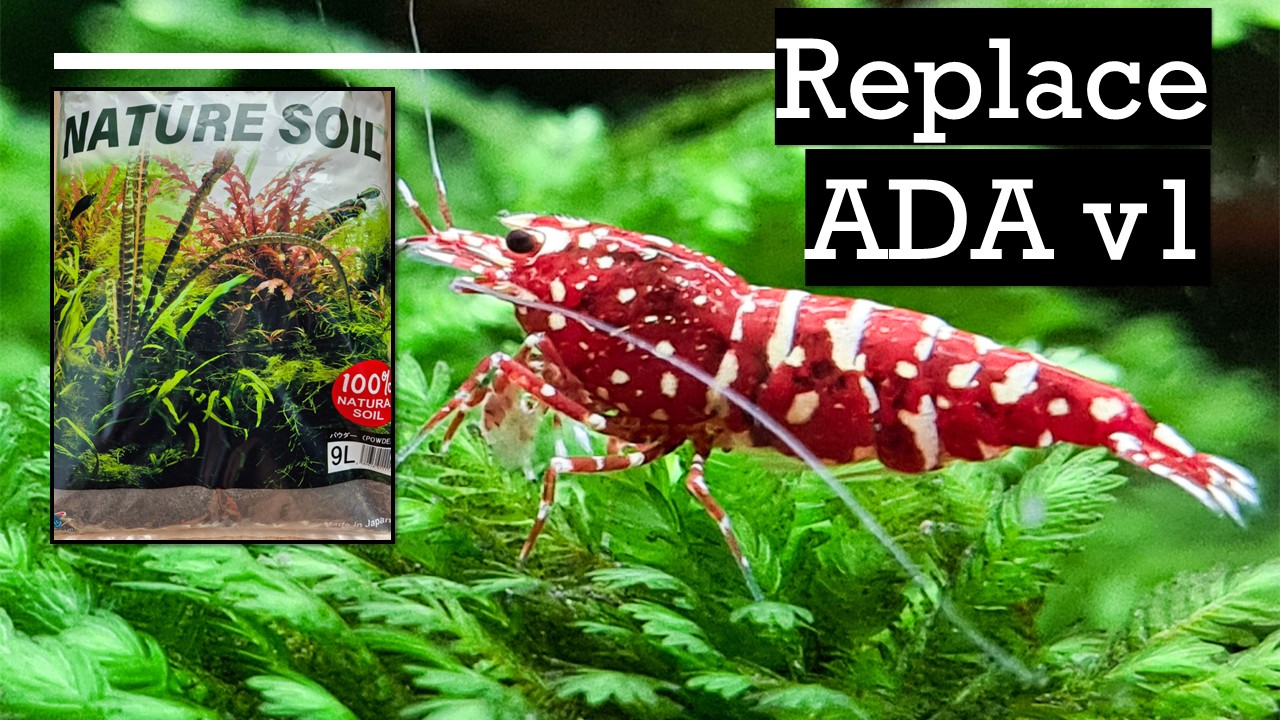
Nature Soil is our go-to replacement for ADA Version 1.
It meets our performance benchmarks, behaves predictably across multiple tank types, and is available in 3 different granule sizes.
There is also a shrimp-specific version that includes added nutrients. But based on our results, the original formula is more than sufficient for Caridina use.
We’re continuing to test the larger granules to see if they can extend reset intervals, but so far, everything points in the right direction.
This soil gives us a stable pH, minimal leaching, and—most importantly—consistent breeding results in real-world tanks.
Chapter 7: Why This Discovery Matters
This isn’t just a product switch. It’s a statement.
We can still find innovation that honors the foundations of our hobby.
We can still raise the bar.
We don’t have to settle for “what’s available.”
Inconsistent soil leads to inconsistent results. And in a hobby as sensitive as shrimp keeping, inconsistency leads to losses, burnout, and a loss of confidence.
Nature Soil restores that confidence.
It gives us control. Stability. A path forward.
And it came to us through community, conversation, and a refusal to compromise.
Chapter 8: How You Can Get It
For those of you in Singapore, feel free to reach out to me directly if you’d like to get your hands on Nature Soil. They come in 9L bags.
For international hobbyists, you can reach out to the manufacturer directly through the email in the description below.
This soil is more than just functional—it represents a shift back to stability and precision for those who care deeply about their shrimp keeping.
Final Thoughts: A Shared Journey
This journey has reminded me of something important: innovation isn’t always about creating something new. Sometimes, it’s about finding what’s right and proving that it works.
This search wasn’t easy.
There were long nights. Delayed progress.
Tanks that sat empty for months while we tested again and again.
But we did it so others wouldn’t have to.
So new hobbyists wouldn’t have to guess.
So breeders could scale with confidence.
So our community could keep thriving.
If you’ve been following this journey, supporting our work, or sharing your own experiences—thank you.
And for those of you who support this work and want to go deeper with us, there’s a members-only video available that walks through more of the technical details and behind-the-scenes footage.
Thank you for being here.
Until next time—take care of your tanks, take care of your shrimp, and let’s keep moving forward together.